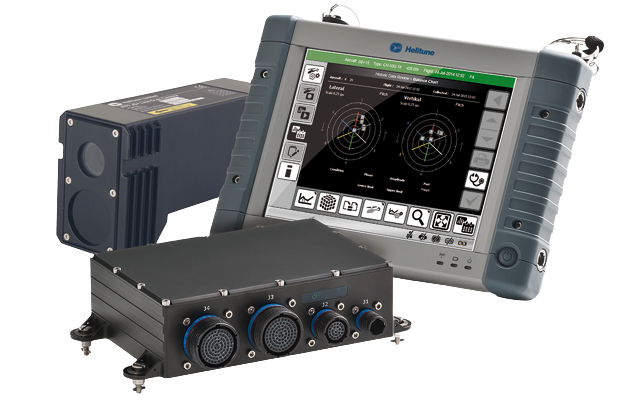

Reducing helicopter rotor track and balance (RTB) time, cost and aircraft downtime in HEMS operations
Client: STAT MedEvac: a Helicopter Emergency Medical Service (HEMS) Operator
- Fleet: 23 helicopters (19 x EC135 and 4 x BK117 C2)
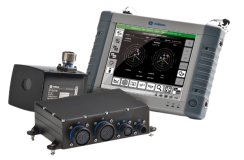
- Solution: Helitune Rotortuner RT-6™ – award-winning technology for precision dynamic balancing, tracking and vibration analysis
Headline outcome
- $53,440 cost savings over six months, with significant reductions in flight time, engineering hours and aircraft downtime.
- Improved balancing and tracking with reduced vibration, vital for critical condition patients requiring urgent medical care.
Client overview
STAT MedEvac is a multi-state Helicopter Emergency Medical Service (HEMS) provider operating across Pennsylvania, New York, Maryland and Ohio. It has 18 operational bases and a fleet of 19 EC135 and four BK117 C2 helicopters.
The challenge
- High number of ground runs and flights per RTB task
- Significant engineering time making single adjustments between flights
- Aircraft operating costs associated with RTB
- Need to reduce the number of airframe hours and engine cycles
STAT MedEvac met Helitune at the then HAI Heli-Expo (now Verticon) in Dallas, Texas. The HEMS operator needed to upgrade its legacy RTB technology, which was approaching the end of its operational life.
Legacy RTB for the EC135 main rotor involved
- 7 adjustment sets
- 4 ground runs
- 3 hover flights
- 3 forward flights
Legacy RTB for the BK117 C2 main rotor involved
- 4 ground runs
- 6 hover flights
- 4 forward flights
- 10 adjustment sets
- 14 engine starts
Legacy RTB for the BK117 C2 tail rotor was even more intensive, requiring many iterations
- 12–15 ground runs (sometimes more than 20) – no flight phases required
- 11–14 adjustment sets
(RTB for the EC135's tail rotor is simpler, involving single-weight adjustment.)
The solution
Deployment of two award-winning Helitune RT-6 units, featuring:
Multi-axis data capture
- Immediate visibility of the full vibration vector
- Faster identification of the root cause
- Fewer trial-and-error adjustments
- More precise calculation of weight changes, pitch adjustments and tab inputs
Minimum Flight Routine (MFR) algorithm
- Analyses all blade track and rotor balance data together, calculating a combined solution across multiple flight regimes
- Integrated solution recommendations – calculates weight changes (amount and position), pitch link adjustments and tab inputs in one solution
- Complies with RTCA/DO-160 – the premier international standard for atmospheric, electromagnetic and physical stresses for avionics hardware
View Helitune RT-6 specifications
Measured results
RT-6 deployment resulted in significant reductions in the number and length of ground runs and forward flights required for both the EC135 and BK117 C2 helicopters.
Over six months, deployment of the two RT-6 units saved the fleet
- $53,445 in total savings
- 59 fewer aircraft hours
- 98 fewer engine cycles
- 33 technician hours saved
STAT MedEvac benefited from reduced operating costs, increased aircraft availability, improved maintenance efficiency and lower mechanical stress and risk.
1. EC135 savings
Time spent on ground runs and full flights testing the EC135 main rotor was cut by 60%.
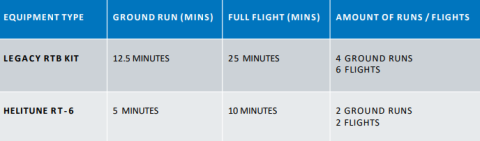
The RT-6 saved $2,363 per RTB on average
- Engine starts reduced from 10 to 4
- Adjustments reduced from 7 to 3
Over six months, the RT-6 saved
- 102 engine cycles
- 48 flying hours
- 34 ground runs
- 68 RTB flights
- 68 adjustments
2. BK117 C2 savings
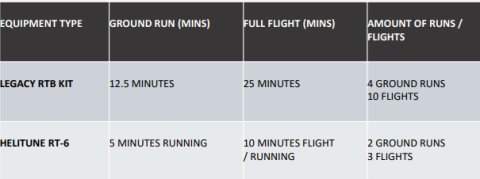
Main rotor
Tail rotor
RTB savings on the BK117 C2 amounted to
Main rotor RTB – $13,635 saved
- 18 engine cycles saved
- 8 hours 40 minutes flying/running time saved
- 4 ground runs saved
- 14 RTB flights saved
- 16 adjustments saved
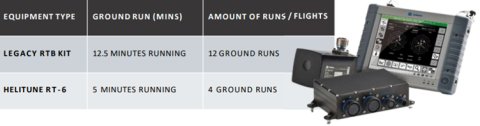
Tail rotor RTB – $3,226 per tail balance
- 8 full ground runs saved
- Reduced running time on 4 additional ground runs
This is an amazing track and balance system, we love it!
Bryan Smith, Maintenance Manager, STAT MedEvac
Every extra minute of operational readiness for these helicopters means a greater chance of life for patients in a critical condition. Reducing vibration becomes ever more crucial when the patient being flown has sustained a traumatic brain or spinal injury.
Sean Carrington, Senior Flight Test Engineer, Helitune
Get expert technical advice
Contact Helitune for further information about advanced helicopter rotor track-and-balance and vibration-monitoring systems.
UK-headquartered Helitune has subsidiaries in Chicago (USA), Munich (Germany) and Cergy (France).
Related products