Practical answers from our engineers
Over many years, Prosig's engineers have written hundreds of articles on noise and vibration measurement, from the basics of sensors and sampling to advanced analysis techniques. They're a practical reference for anyone working with test data, whether or not you use Prosig systems.
What is the difference between microphone types?
Learn about the difference between free field, diffuse field and pressure microphones.
We are often asked what is the difference between free field microphones, diffuse field microphones and pressure microphones.
For a run-of-the-mill ½ inch microphone, the short answer is nothing.
However, the long answer is a bit more involved.
Basically, if the frequency range is below 16 kHz and an accuracy of ±2dB is acceptable, then there is no real difference between the types.
So, what is the difference between these types of microphones?
Well, first you have to understand the different types of sound field involved.
In theory, a free field is a sound field where the sound waves are free to expand outwards forever from the source. That is, we assume that there are no reflections or reverberations. In practice, we would consider an anechoic chamber to be a free field or an outdoor measurement, provided we measured at a sufficient distance from the ground.
A diffuse field or a random incidence field, is a sound field where the sound waves arrive equally from all directions. Another way to think of a diffuse field is that you have sounds coming from different directions in succession with no time in between their arrival. For example, in a diffuse field the sound waves that arrive at a person’s ears are so completely different that the brain finds it impossible to work out where the sound came from.
A pressure field is a sound field where the sound pressure has the same magnitude and phase at any position in the sound field.
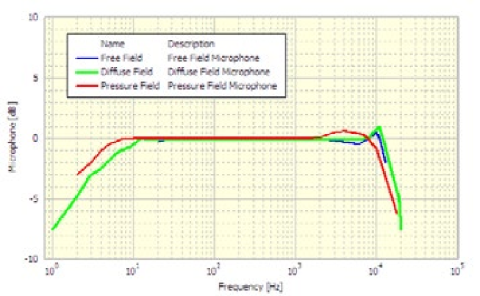
It is important to understand that all of these microphone types are fundamentally the same. They are transducers that are designed to sense pressure levels in air. The differences between them are in the designs of the microphone heads. Each type of microphone will normally be supplied with a calibration data sheet that will show the frequency response against sound pressure. Comparing the frequency response against sound pressure for the three microphone types will show the differences clearly.
The differences between the three types of microphone generally occur at higher frequencies as we stated previously, below about 16 kHz, the response from each will be similar. This is partly to do with the physical size of the microphone with respect to the wavelength of the sound being measured.
Free field microphones are designed to compensate for the effect of the microphone itself in the field. So you measure the sound as though the microphone was not there. They are designed this way because the microphone's presence will affect the propagation of the sound wave. A free field microphone should be pointed towards the sound source at a 0° angle of incidence.
Diffuse field microphones are designed to respond in a uniform manner to any signal arriving on their measuring surface from any angle.
Generally, these tend to be oriented at about 75° to the direction of the sound wave propagation in a free field.
Pressure microphones are designed to respond with a uniform frequency response to the sound level itself. When used in a free field, mount a pressure microphone at 90° to the sound wave propagation direction so the sound passes the microphone's measuring face.
Have a question about this article? Email our support team.
Browse all articles
Our full library of articles, tutorials and how-tos is available on the Prosig Noise and Vibration Blog.
How impact hammer testing reveals a structure's natural frequencies, damping and mode shapes, and how to get reliable results.
Why you might change the sample rate of your data, and how to do it without introducing errors such as aliasing.
What a frequency response function is, how it's measured, and how to read one to understand a structure's behaviour.
How acceleration, velocity and displacement relate to each other, with simple conversion formulas and the pitfalls to avoid.
A guide to measurement microphones: free-field, pressure and random-incidence responses, polarisation and size, and how to choose the right one.
Why window functions change the values in your spectrum, and when to apply amplitude correction or energy correction.
Have a question we haven't answered?
Get the latest DATS software updates and patches for your licensed system.
Watch Prosig systems in action, with tutorials and explainer videos on our YouTube channel.
Open and view DATS data files with our free viewer, no licence needed.
Our free 7th edition guide to sensors, measurement and analysis.
Tell us how we’re doing. Your feedback helps us improve our products and support.

From aerospace and automotive testing to condition monitoring and human vibration research, explore how Prosig's measurement solutions are applied across demanding engineering environments.
Worldwide support, local expertise
Our support team is based in the UK, with offices in the USA and a network of distributors worldwide providing local sales and support.

Our sites

Distributors