

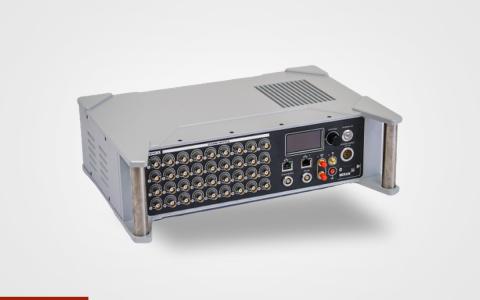
PROTOR
PROTOR is a complete online vibration monitoring system for rotating machinery, combining rugged acquisition hardware with powerful analysis software.
Monitor up to 32 channels per unit, on one machine or several, with synchronous or time-based acquisition that adapts automatically to run-up, run-down, overspeed and slow roll conditions.
Detect developing faults early, from imbalance and misalignment to rubs, bearing faults and shaft cracking, with flexible alerts that help you act before damage occurs.
Access real-time and historical data on site or remotely, and plan maintenance around production to reduce downtime and avoid unplanned shutdowns.
Available as a permanent rack-mounted installation or a portable unit, built to withstand demanding power station environments.
Description
PROTOR is a complete hardware and software solution for online vibration monitoring of rotating machinery. Acquisition units monitor your machines and are networked to a central server, giving engineers access to real-time and historical data either on-site or remotely via LAN, WAN or VPN. Data and reports are presented in both graphical and numerical formats.
Available as a rack-mounted unit for permanent installation or as a portable system, PROTOR is rugged and built to withstand the demanding conditions typically found in power stations. A range of configurations gives you full flexibility over the number of channels and machines you monitor.
Key benefits
Improved efficiency
Reliable diagnostics reduce downtime and improve overall plant efficiency.
Lower capital costs
Extending machine service life reduces the need for costly replacement.
Better machine health data
Supports predictive maintenance, helping to avoid or limit machine damage.
Improved safety
Early warning of developing faults reduces the risk of unexpected failure, damage and injury.
Data where you need it
Data is delivered to your desktop, whether you are on site or working remotely.
Reduced servicing
Repair or replace only the parts that are genuinely damaged or worn.
Lower repair costs
Recognise problems before they cause serious damage.
Reduced downtime
Machines can be monitored and maintained while they remain in service.
Fewer shutdowns
Scheduled maintenance can be planned around production requirements.
Flexible system configuration
The standard PROTOR unit provides stand-alone monitoring and storage for up to 32 channels and 4 tachometer or phase reference signals. Where fewer channels are needed, the system can be configured with 8, 16 or 24 channels, supporting 1, 2 or 3 tachometer signals respectively.
PROTOR can monitor a single machine, with all 32 channels captured relative to one phase reference, or multiple machines, with a tachometer signal associated with each block of 8 channels. Multiple chassis can be combined for larger installations.
Data acquisition and storage
PROTOR provides high-quality, high-speed data acquisition and analysis. Data is acquired synchronously with a once-per-revolution tachometer signal for highly accurate harmonic and sub-harmonic measurements, or on a time basis for slow-speed conditions or where no tachometer signal is available.
A standard signal conditioning module accepts inputs from accelerometers, velocity probes and displacement probes, and the system also supports IEPE/ICP® transducers. Gain, AC/DC coupling and anti-aliasing filter selection are all programmable.
Signal inputs are true differential with high common-mode rejection, making them well suited to transducer signals in industrial environments. PROTOR can run alongside an existing protection or supervisory system, and where raw signals are shared, high-impedance galvanic isolation is available as an option.
The system automatically detects plant operating conditions, including on-load, overspeed, run-up, run-down, barring and slow roll, and adapts its acquisition technique to suit.
User interface and connectivity
PROTOR can be accessed directly via standard monitor, keyboard and mouse ports, or over Ethernet. Typically, engineers connect using a Windows laptop via Ethernet or through an existing station network, which can also provide remote access where WAN or VPN facilities are available. Once configured, PROTOR can be left unattended to collect and store data to its internal disk.
The intuitive graphical user interface makes it easy to select display types and channels using simple point-and-click menus. Screenshots can be copied straight into standard Windows applications, and data can be easily exported.
Displays
- Run-ups and run-downs
- Vector plots
- FFTs
- Order plots
- Waterfalls
- Cascade and overlay X-Y plots
- Combined vibration and plant process parameter plots
- Mimic diagrams
- Orbits
- Numerical displays
- Trend plots
- Bode plots
- Shaft gap displays
- Demand time and spectra
- Reference overlays during run-up and run-down
Fault detection
PROTOR helps engineers identify a wide range of machine faults, including:
- Shaft imbalance
- Whirl problems
- Shaft rubs
- Bearing faults
- Shaft bowing
- Balance piston rubs
- Damaged sealing strips
- Misalignment
- Shaft cracking
- Looseness
- Casing distortion
- Generator shorts
- End winding vibration
- Blade response
- Hub cracking
Alerts, alarms, diagnostics and prognostics
Alert processing includes:
- Amplitude exceedance for overall and selected orders
- Exceedance of elliptical boundaries in amplitude and phase
- Exceedance of the difference between RMS and sum of harmonics
- Sub-synchronous amplitude exceedance
- Step alerts
- Banded spectra alerts
- Vibration alerts dependent on plant process parameters
- Filtering of wild alerts
Specification
| Power requirements | 24 V DC. External 110/220 V AC to 24 V DC power supply included. |
|---|---|
| Input channels | 16, 24 or 32 channels per chassis. Multiple chassis may be configured for expansion. |
| Resolution | 16-bit |
| Maximum sample rate | 20k samples/second/channel |
| Input frequency range | DC to 10 kHz |
| Input coupling | Programmable DC direct, or AC with 1 Hz high-pass filter |
| ICP transducer support | 4 mA supply from 24 V source |
| Input voltage | Programmable ±24 V, ±10 V, ±1 V, ±100 mV |
| Input impedance | 800 kΩ. Galvanic isolation available as an option. |
| Maximum common-mode voltage | ±200 V common-mode compliance. Galvanic isolation available as an option. |
| Anti-aliasing filter | Programmable 8-pole Butterworth low-pass filter, 200 Hz to 20 kHz |
| Phase matching | Better than 1° between channels. Phase compensation for filter delays performed. |
| Tacho input range | ±24 V |
| Tacho frequency range | 0 to 120,000 RPM |
| Tacho conditioning | Dedicated conditioning for 2 tachometer signals per unit. Programmable threshold, slope and re-trigger period. |
| Speed reading accuracy | Better than ±1 RPM |
| Synchronous sampling | Programmable synchronous sampling circuitry providing 16, 32, 64, 128 or 256 pulses per cycle |
| Constant sampling | Programmable constant-rate sampling clock |
| Frequency analysis | Overall level and DC component; harmonic amplitude and phase analysis for orders 1x, 2x, 3x, 4x and a selected order; sub-synchronous amplitude and frequency; non-synchronous energy; window selection (Hanning or flat-top); spectral banding mode |
Prosig maintains a policy of continuous product development and improvement. Specifications may be subject to change without notice.